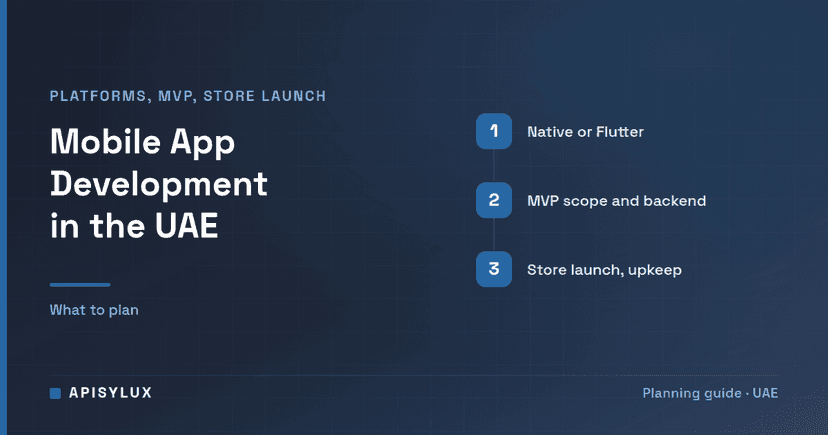
Flutter and native development are both capable of producing a serious mobile app for a UAE business, and the choice is rarely decided by raw performance. It is decided by how much of the product is platform-specific: a shared Flutter codebase covers iOS and Android from one team, while native development means two codebases, two toolchains and two release trains that can diverge on purpose.
Key takeaways
- Choose on how platform-specific the product is, not on which framework benchmarks better.
- Flutter does not lock you out of native APIs - platform channels are the documented escape hatch.
- Flutter adapts OS-level behaviour automatically; platform conventions remain your design decision.
- The backend and admin dashboard usually cost more than the app screens either way.
- Two native codebases are a choice to maintain two roadmaps, so make it deliberately.
- In the UAE, assume both stores matter from release one and plan Arabic and right-to-left support up front.
What is the actual difference?
Native development means building separate iOS and Android applications with each platform's own tooling and language. Flutter compiles a single Dart codebase to both, drawing its own interface rather than wrapping platform widgets. Neither is automatically right, and the honest framing is that Flutter trades some platform-specific control for one team, one backlog and one place to fix a bug.
| Decision area | Flutter | Native iOS and Android |
|---|---|---|
| Delivery speed | Often faster for one shared app experience | More work when both platforms launch together |
| UI consistency | Strong cross-platform consistency by default | More platform-specific interface control |
| Device features | Works well for most business apps; native code via channels | Direct access to platform APIs on day one |
| Team structure | One product team can cover both platforms | May need separate iOS and Android expertise |
| Release cadence | One build pipeline, two store submissions | Two pipelines that can ship independently |
| Divergent roadmaps | Possible but works against the shared codebase | Natural - each platform can go its own way |
| Maintenance | Shared code reduces duplicate work | Platform changes are handled independently |
Does Flutter lock you out of platform APIs?
No, and this is the objection most often raised by people who have not had to test it. Flutter documents platform channels as the supported mechanism for calling platform APIs in a non-Dart language, with messages and responses passed asynchronously between the Dart side and the host so the interface stays responsive. The documentation lists the platform languages it supports for this: Kotlin and Java on Android, Swift and Objective-C on iOS, C++ on Windows, Objective-C on macOS and C on Linux. It also documents the Pigeon package, which generates type-safe code from a definition written in a subset of Dart so the two sides do not have to agree on strings by hand.
Need help with Mobile Development?
Get a free strategy session with our experts — no commitment required.
The practical reading for a buyer is that "we need a native SDK for X" is not a reason to reject Flutter by itself. It is a reason to ask how much native code the product needs, who will write it, and whether that person is on the team. A Flutter app with two small platform channels is still a Flutter project. A Flutter app with a dozen of them has quietly become two native projects with extra steps.
Where does a Flutter app stop feeling native?
Flutter's own documentation on automatic platform adaptations draws a distinction worth carrying into a scoping meeting. It separates behaviours of the OS environment, such as text editing and scrolling, which would simply be wrong if they differed, from things conventionally implemented in apps using the platform SDKs, such as parallel tabs on iOS or an Android alert dialog. Flutter handles the first case automatically and states plainly that for the second it bundles the means to produce the platform effects but does not adapt automatically where app design choices are needed.
The automatic half is more thorough than most people expect: the documentation describes different default navigation transitions on each platform, an iOS edge-swipe back gesture against the Android system back button, and distinct scroll physics - iOS scrollables carry more weight and dynamic friction while Android has more static friction - along with Android's overscroll glow versus the iOS rubber-band snap-back. What is left to you is the conventional layer, and that is exactly where "the app feels non-native" complaints come from. Budget the design decision, not a rewrite.
When is Flutter a strong fit?
- Business apps, booking tools, dashboards, field-service apps, delivery workflows and internal operations apps.
- Products that need iOS and Android quickly with one shared user experience.
- Teams that need a controlled first release before investing in platform-specific optimisation.
- Organisations that cannot staff and retain two separate mobile specialisms.
When is native the better call?
- Apps leaning heavily on advanced device APIs, platform-specific interactions, or high-performance media and graphics.
- Products where the iOS and Android roadmaps are intentionally different.
- Teams with existing native engineering capacity and a long-term platform investment to protect.
- Products where a platform's newest capabilities are the differentiator and waiting for ecosystem support is not acceptable.
What does this mean for a UAE business?
Plan for both stores from the first release. A Dubai or Sharjah customer base is genuinely split across iOS and Android, and staff-facing apps for drivers, technicians and site teams rarely run on a single standardised handset, so "Android first, iOS later" is usually a delivery preference rather than a market fact. That assumption pushes many UAE operational apps toward a shared codebase for the first release, with native modules added only where the product proves it needs them.
Two more local requirements belong in the estimate rather than in a later change request. Arabic support means right-to-left layout and a second content pipeline, not a translation file dropped in at the end. And field apps used across the emirates spend real time in basements, tunnels and airport service roads, so offline tolerance and a visible sync state are core requirements for either technology choice.
Apisylux delivers mobile app development across cross-platform development, iOS app development and Android app development. For operational products, the backend, roles and admin dashboard usually decide the schedule more than the app screens do. To size the platform decision against your own feature list, book a mobile scoping session.
Frequently asked questions
Is Flutter enough for a serious business app?
For most business workflows, yes. What decides the outcome is architecture: clean backend APIs, role-based access, testing, analytics and a support plan matter more than the framework, and a badly structured native app fails in exactly the same places.
Can a Flutter app be expanded later?
Yes. A well-structured Flutter app grows through phased releases, and platform channels allow native modules to be added for specific needs when they are justified rather than assumed.
Does Flutter vs native app development change the UAE launch timeline?
It changes how much work sits before the two store submissions, not the review itself. One shared codebase usually means one build pipeline and a single feature freeze; two native codebases mean two, which is an advantage only if the platforms genuinely need to ship different things.
What usually costs more than the app itself?
The backend and the admin side. Authentication, roles, notifications, reporting and the dashboard operations staff use every day tend to outlast and outweigh the mobile screens, whichever framework draws them.