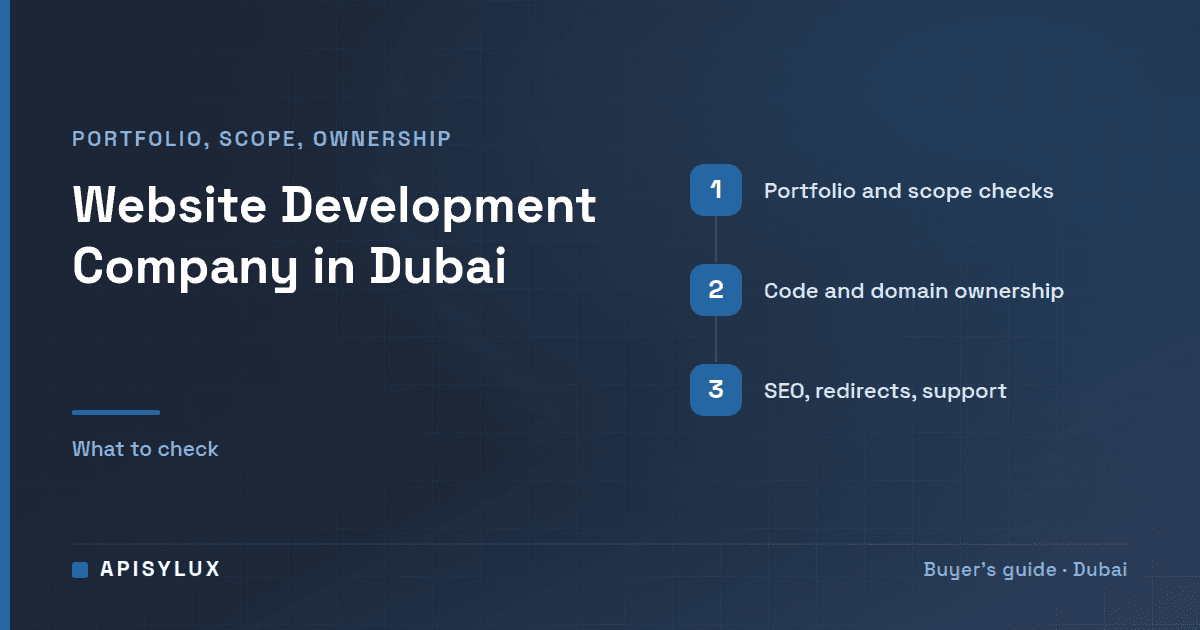
Choosing a web development company in Dubai is one of the most consequential technology decisions your business will make. Your website is the anchor of your digital presence — the destination for every ad campaign, every Google search, and every referral. Getting it wrong costs time, money, and market position. This guide gives you a framework to evaluate and select the right partner, whether you are shortlisting a website development company in Dubai for a first site or replacing a supplier you have outgrown.

What to Look For in a Dubai Web Development Company
The technical capabilities you need depend on your project, but certain qualities are non-negotiable for any professional engagement:
Need help with Web Development?
Get a free strategy session with our experts — no commitment required.
- Proven portfolio with live sites: Ask for URLs, not just screenshots. Visit the sites, check load speed, test on mobile, and review Google PageSpeed Insights scores.
- Discovery-first process: A credible company starts with questions about your business, users, and goals — not a quote. Beware agencies that quote within 24 hours without understanding your requirements.
- Post-launch support commitment: Websites require ongoing updates, security patches, and performance monitoring. Confirm they offer retainer or SLA-based support.
- Clear ownership of code and domain: Ensure the contract states you own the codebase, domain, and hosting account outright.
- Bilingual capability: If any part of your audience reads Arabic, your developer must have experience with RTL layouts and bilingual CMS configuration.
What to Evaluate Before Comparing Proposals
Settle five questions inside your own team before you ask any agency for a price. Proposals only become comparable when every supplier is quoting against the same answers, and the answers also tell you what kind of website development in Dubai you actually need.
| Area | What to ask | Why it matters |
|---|---|---|
| Business goal | Which action must the site produce: an enquiry, a booking, a purchase or a sign-up? | Layout and copy should serve one measurable conversion path. |
| Content model | Who edits services, articles, careers and case studies once the site is live? | The CMS or admin workflow has to suit the people who will use it every week. |
| SEO foundation | How are titles, schema, redirects, page speed and internal links handled? | Technical and content hygiene costs least when it is built in from the first sprint. |
| Integrations | Do forms feed your CRM, email, analytics or WhatsApp follow-up? | An enquiry loses value for every hour it waits to be copied across by hand. |
| Ownership | Who holds the code, domain, hosting and admin logins? | Lock-in becomes an operating risk the day you want to change supplier. |
If the answers point to client portals, calculators, booking flows or CRM routing that a template cannot carry, you are describing a custom software development project rather than a brochure site, and the proposals should say so. If the answers are mostly about presentation, agree the interface early through UI/UX design so that developers build against approved screens. Our website development service in Dubai page shows how we scope each case, and businesses based in Sharjah or Ajman can start from the pages written for those areas.
Types of Web Development Companies in Dubai
| Type | Best For | Indicative Range (AED, our planning estimate) | Watch Out For |
|---|---|---|---|
| Boutique agencies (2–10 people) | SMBs wanting personal attention and direct developer access | 15,000 – 80,000 | Key-person dependency — what happens if your lead dev leaves? |
| Mid-size agencies (10–40 people) | Growing companies needing structured process, multiple skills | 50,000 – 300,000 | Account managers adding overhead; scope creep |
| Enterprise agencies / system integrators | Large corporates with complex integrations, compliance needs | 200,000 – 2,000,000+ | High overhead costs baked into pricing |
| Freelancers | Small brochure sites, tight budgets | 3,000 – 20,000 | No team backup, inconsistent quality, availability risk |
These ranges are our own planning estimates, not market statistics.
Red Flags to Avoid
- Hosting lock-in: Agencies that only host on their own servers and won't give you hosting account access are creating dependency to retain you.
- Template sites sold as custom: Ask directly: "Is this built on a template or page builder?" A WordPress site using Elementor is not custom development — yet it is sometimes sold as such.
- No written specification: If they won't provide a written scope of work before signing, disputes are inevitable.
- Guaranteed Google rankings: No agency can guarantee a specific organic ranking. Treat promises such as "page 1 in 30 days" as a serious warning sign, especially when no technical SEO, content, or authority-building plan is documented.
- Payment milestones tied only to delivery, not acceptance: You should only make final payment after you have reviewed and approved the delivered work.
Ownership and Redirect Checklist
These checks decide whether you can leave, audit or grow the site later. Ask for each one to appear as a line in the written scope.
- Redirect map: every address on an existing site is mapped to its new equivalent before launch. Google recommends permanent redirects such as 301 and 308, and advises pointing straight at the final destination rather than through a chain (Google Search Central, site moves with URL changes).
- Redirect lifetime: the same Google guidance says to keep redirects in place for as long as possible, generally at least a year, so agree who maintains them after handover.
- Registrar login: you hold the credentials, so a change of supplier never needs the agency's cooperation.
- Handover pack: written deployment steps and admin access are delivered on launch day.
- Tracking and forms: analytics events and form delivery are tested end to end before go-live, not after the first missed lead.
- Support window: the agreement names who responds after launch, how quickly, and what is covered.
Questions to Ask Before Signing
- Who will be my day-to-day contact, and what is their role on the team?
- Can I see the codebase at any point during development?
- What CMS or framework will you use, and why is it right for my project?
- How do you handle browser and device compatibility testing?
- What is your process if a feature I approved doesn't work as expected after launch?
- Do you provide Core Web Vitals optimisation as part of the build?
- Who handles DNS and SSL certificate management?
Realistic Pricing Expectations for Dubai
Dubai web development pricing depends on scope, design depth, CMS requirements, integrations, content, SEO setup, testing, and support. The planning ranges below are useful for comparing proposals, but the final quote should always map back to a written scope of work. The website cost calculator gives a first estimate, and our breakdown of website development cost in Dubai covers budget, scope and the warning signs inside low quotes.
| Project Type | Estimated Cost (AED) | Timeline |
|---|---|---|
| 5-page brochure site | 8,000 – 20,000 | 3–5 weeks |
| Business website (10–20 pages) | 20,000 – 60,000 | 5–10 weeks |
| eCommerce (Shopify/WooCommerce) | 25,000 – 100,000 | 6–12 weeks |
| Custom web application | 80,000 – 500,000+ | 3–9 months |
| Enterprise portal / integration | 200,000 – 2,000,000+ | 6–18 months |
Are You Ready to Choose a Web Development Partner?
Before engaging an agency, it is worth assessing how well-defined your requirements are and how prepared your organisation is for a web project. Use the self-assessment below to find out where you stand.
Frequently Asked Questions
How long does it take to build a website in Dubai?
A basic 5-page website takes 3–5 weeks. A full business website with custom design, CMS, and SEO setup takes 5–10 weeks. A custom web application takes 3–9 months. Timelines extend when client feedback cycles are slow.
Should we choose WordPress or Next.js for a Dubai business website?
WordPress is a valid choice for most SMB brochure and content sites. It has a large plugin ecosystem, a large global developer pool, and reasonable maintenance cost. Next.js can be a stronger fit for performance-focused, integrated or app-like sites, and for high-traffic or complex applications, a headless CMS architecture is worth considering. The deciding factors are scope and who will edit content, so read our comparison of WordPress and custom website development in Dubai before you commit.
What is the first step before contacting agencies?
Write down your target pages, required forms, content owners, integrations and conversion goals, using the evaluation table above. Then ask each agency to quote against that same list, or book an estimate discussion to turn it into scope, budget and timeline.


