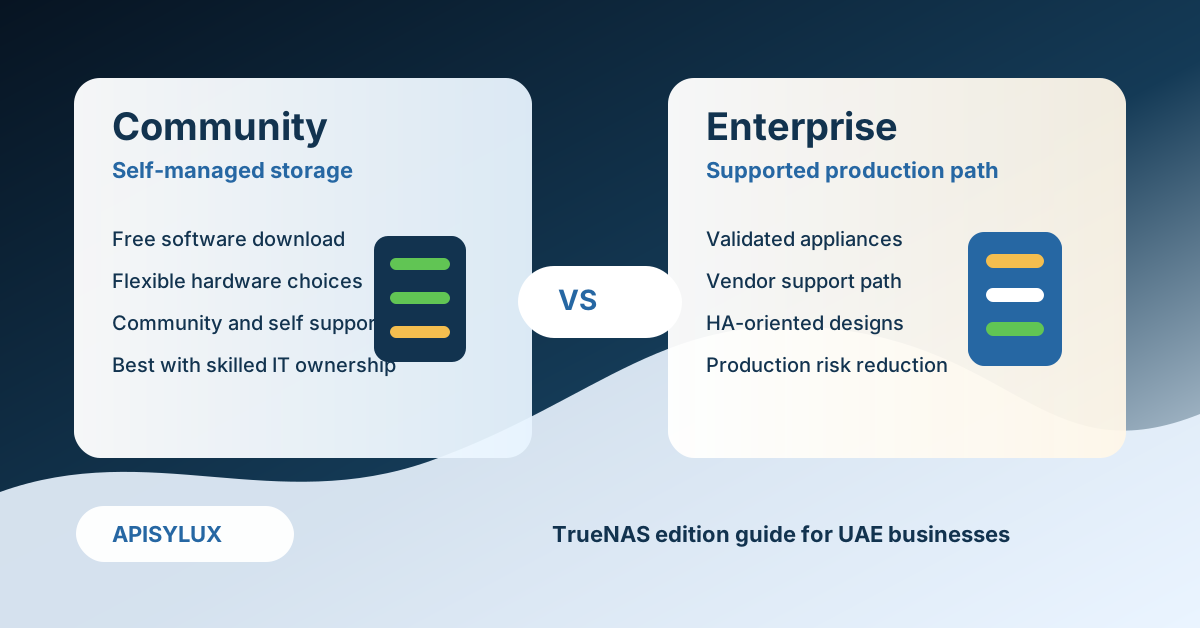
TrueNAS Community Edition and TrueNAS Enterprise are built for different ownership models. Community Edition is the free self-managed route for teams that can design, operate, update, monitor, and troubleshoot storage themselves. TrueNAS Enterprise is the supported appliance route for companies that want iXsystems-backed hardware, enterprise support, high-availability options, and a clearer production escalation path.
For UAE businesses, the question is not simply "free or paid." The real question is whether the storage system is a lab platform, an office file server, a backup target, or a critical production service where downtime affects operations, client delivery, compliance evidence, or revenue.
Need help with IT Infrastructure?
Get a free strategy session with our experts — no commitment required.
- Quick answer
- What the editions are
- Shared storage foundation
- Support and operational risk
- Hardware and high availability
- Updates and lifecycle planning
- Cost model
- Comparison table
- UAE decision framework
- Sources checked
Quick answer
Choose TrueNAS Community Edition when the business has capable IT ownership, accepts community support, can tolerate planned maintenance windows, and is using the system for lab storage, non-critical office shares, backup targets, development, or budget-sensitive deployments.
Choose TrueNAS Enterprise when storage availability matters to production operations. Enterprise is the better fit when the company needs vendor support, validated appliances, high-availability architecture, formal escalation, lifecycle guidance, and a supported platform for business-critical file, backup, virtualization, or object storage.
What the editions are
TrueNAS Community Edition is the free community download. It is designed for self-managed deployments on suitable hardware. It gives businesses access to the TrueNAS storage platform without a software license fee, but the company or its IT partner owns design, updates, monitoring, backup policy, recovery testing, and incident response.
TrueNAS Enterprise is the commercial iXsystems appliance and support path. Official TrueNAS Enterprise materials position it for enterprise file, block, and object storage, with OpenZFS data protection, enterprise appliances, support, and scale options. It is not only about extra features; it is about reducing production risk through supported hardware and a vendor escalation path.
Avoid old shorthand such as "Community equals CORE/SCALE" as a current buying rule. TrueNAS naming and release tracks have changed over time, so use the current TrueNAS Community Edition, Enterprise, and software-status pages when making a production decision.
Shared storage foundation
Both routes are tied to the same broad TrueNAS storage foundation: OpenZFS, storage pools, snapshots, replication, SMB/NFS style file services, block storage patterns, and administrative controls. TrueNAS documentation describes ZFS as a copy-on-write file system with checksums, snapshots, replication, scrubs, compression, mirrors, and RAIDZ options.
This means Community Edition can be technically strong when it is designed well. A poor disk layout, weak backup design, missing alerts, or underpowered server will create risk regardless of edition. Likewise, Enterprise is not a substitute for backup governance. RAID, snapshots, and HA improve availability and recovery options, but they do not replace offsite backup and restore drills.
For normal office file sharing, TrueNAS SMB can serve Windows, macOS, Linux, and BSD clients. For production business use, Active Directory or a structured identity model should be part of the design, not an afterthought.
Support and operational risk
The biggest practical difference is support accountability. Community Edition relies on your internal team, documentation, community forums, and any third-party IT provider you retain. That may be acceptable for smaller workloads or companies with strong in-house infrastructure skills.
Enterprise changes the support model. When storage is tied to client delivery, finance records, media production, virtualization, or business backups, escalation time matters. Vendor-backed support, validated appliance design, replacement planning, and production guidance can be worth more than the software feature difference.
For Apisylux clients, this is usually the deciding question: who owns the 2am incident? If the answer is unclear, the environment needs either Enterprise support or a managed storage support contract.
Hardware and high availability
Community Edition can run on suitable x86 hardware, which is attractive for cost control and custom builds. That flexibility is also a responsibility. You must choose server-grade disks, memory, network, HBA/controller mode, UPS, cooling, spare strategy, monitoring, and a storage layout that fits the workload.
Enterprise is appliance-led. The hardware, support path, and availability design are part of the purchase decision. If the business requires high availability, redundant controllers, formal support, or a validated storage appliance for a production environment, Enterprise is usually the safer route.
High availability should be treated carefully. It helps with specific hardware or controller failure scenarios, but it does not make data immune from accidental deletion, ransomware, bad updates, application corruption, or poor backup design.
Updates and lifecycle planning
Community Edition users need a disciplined update process. That means reading release notes, checking the TrueNAS software-status guidance, backing up configuration, testing restore paths, and scheduling maintenance windows. Do not update a production storage server casually during business hours.
Enterprise buyers should still plan update windows, but they have a more formal support relationship and appliance lifecycle path. For companies that do not have deep storage expertise, that guidance reduces operational uncertainty.
Whichever edition you choose, document the storage lifecycle: release track, update cadence, config backup, snapshot retention, replication target, offsite backup, spare disks, alert routing, and restore-test frequency.
Cost model
Community Edition has no software license cost, but it is not free production infrastructure. The real cost includes hardware, disks, UPS, rack or office environment, network upgrades, monitoring, backups, IT time, troubleshooting, and downtime risk.
Enterprise has higher upfront or contracted cost, but it can reduce hidden operational cost when the business needs support, validated hardware, faster escalation, and clearer accountability. For mission-critical storage, the cheapest option on day one can become expensive during the first serious outage.
Use the TrueNAS storage calculator to estimate usable capacity before purchase. Then validate the design with growth reserve, snapshot overhead, replication, backup retention, spare policy, and expected restore time.
Comparison table
| Factor | Community Edition | Enterprise |
|---|---|---|
| Best fit | Self-managed labs, office shares, budget-sensitive deployments, skilled IT teams | Production storage, business-critical workloads, support-backed appliance deployments |
| Software cost | No software license fee | Commercial appliance and support model |
| Support | Self-support, documentation, community, or third-party IT provider | Vendor support and formal production escalation path |
| Hardware | Suitable self-selected x86 hardware | iXsystems TrueNAS appliances and validated configurations |
| Availability design | Depends on your hardware and architecture | Better fit for supported HA and production appliance designs |
| Operational burden | Higher internal responsibility | Lower uncertainty when vendor support is required |
| Main risk | Underestimating design, update, monitoring, and recovery ownership | Buying Enterprise without still implementing backup, access governance, and restore testing |
UAE decision framework
- Small office file server: Community Edition can work if an IT provider will manage storage, updates, alerts, snapshots, and backups. Synology may also be considered if appliance simplicity is the top priority.
- Backup repository: Community Edition can be cost-effective, but isolate backup credentials, replicate offsite, and test restores. For business-critical backups, Enterprise or managed support is safer.
- Virtualization or production app storage: Start with Enterprise or a carefully managed design. Latency, network, redundancy, support, and maintenance windows matter.
- Media, CCTV, or large files: Community Edition may be technically strong if hardware is sized correctly. Enterprise is better when downtime and support accountability matter.
- Compliance-sensitive records: Choose based on governance, hosting location, access controls, audit logging, backup immutability, restore evidence, and support accountability. Edition alone does not create compliance.
For a broader buyer view, compare this article with the TrueNAS vs Synology business NAS guide. If TrueNAS is already the preferred platform, Apisylux can help with TrueNAS storage solutions, private server hosting, backup design, monitoring, and recovery testing.